
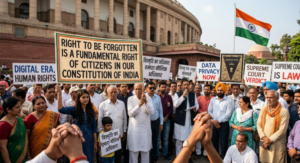
Once personal data is stored on the internet, removing it entirely from the vast web can be a major challenge.
People make mistakes—some intentional and others unintentional—but if an individual is implicated in a case and subsequently acquitted by the court (found not guilty), they have the right to demand the removal of certain personal information from digitally stored platforms.
Criminal records inevitably create obstacles in a person’s future life, regardless of whether they were actually guilty or merely became entangled due to a legal loophole.
Meaning of right to be forgotten:
The “right to be forgotten” is a part of the fundamental right that allows an individual to request the removal of their outdated or irrelevant personal data from digital platforms, as such information can be detrimental to their privacy and potentially lead to significant problems in their future life.
Many nations have implemented this law, and its impact is evident in India as well.
India’s perspective on the right to be forgotten:
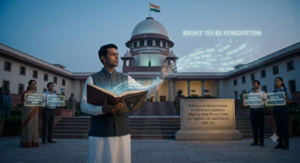
In India, the 2017 ruling in Justice K.S. Puttaswamy v. Union of India can be cited in this context.
The Court acknowledged that the ‘right to be forgotten’ falls under the right to privacy but is not an absolute right; it does not apply in certain scenarios such as public interest, public health, archiving, research, or legal claims.
Various judgments regarding the right to be forgotten have been delivered over time; for instance, a Supreme Court order in 2021 stated that a mechanism should be established to remove details of couples’ marital disputes from search engines.
Meanwhile, in 2023, the Kerala High Court held that the right to be forgotten does not apply to ongoing court proceedings.
In 2024, the Himachal Pradesh High Court ruled that in rape cases, the names of both the victim and the accused must be removed following an acquittal to ensure that individual privacy rights are not violated and privacy is maintained.
In the recent case of Laksh Vir Singh Yadav v. Union of India, 2026, the Delhi High Court observed that the right to be forgotten is a significant component of the fundamental right to privacy, which is encompassed within Article 21 of the Constitution of India.
Adopting a balanced approach, the Delhi High Court stated that while considering the right to be forgotten, it is also essential to weigh the principle of open justice against the need to protect the reputations of citizens.
Extent of the right:
It is necessary to prevent online searches based on the names of individuals mentioned in past judgments—specifically those acquitted of sexual offences or involved in resolved matrimonial disputes.
High Courts have directed search engines and legal databases (such as Indian Kanoon and Google) to de-index or mask the names of these individuals.
The Court maintains that while it is essential to retain an individual’s data in official court records for reference purposes, this information should not be easily accessible to the public.
Exceptions:
The ‘right to be forgotten’ is not an absolute right for an individual; rather, it represents a balanced approach between the right to freedom of expression and the right to information.
- Exceptions to this right apply if an individual has been convicted of a serious crime committed against women or children.
- Exceptions also apply in cases involving a breach of public trust or corruption by a public servant or an elected representative.
- Exceptions further apply to information that is relevant for journalistic, legal, or public interest purposes.
Conclusion:
The ‘right to be forgotten’ involves a balancing act between freedom of expression and the right to information; it is not an absolute right, and its application is determined by the courts. Under this right, an individual’s entire information profile is not erased or hidden; rather, specific personal data is masked or de-indexed. This right plays a crucial role for the individual, helping them move forward in society, restore their reputation, and rebuild a positive image in the public eye.